
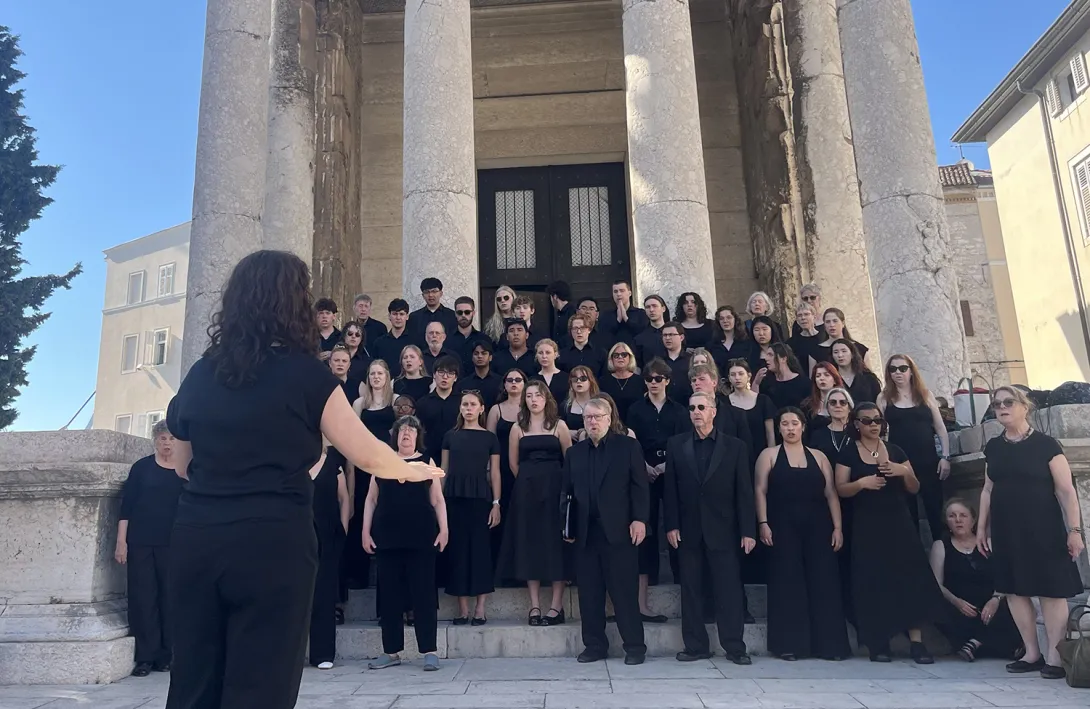
Students performed in Slovenia, Croatia and Austria while building international musical partnerships, exploring regional choral traditions and concluding the academic year with a memorable cultural exchange.
Moving across European borders with a repertoire spanning centuries and styles, the musicians of Lehigh University Choral Arts (LUCA) recently concluded a multicity, three-country concert tour through Slovenia, Croatia, and Austria. The tour, which ran from May 18 through May 29, marked the ensembles’ return to international touring, blending historical education with deep cultural and musical exchanges.
Led for the first time by directors Dr. Sarah Frook Gallo and Dr. Liz Olson, the trip served as both a debut for new ensembles members and a final, emotional sendoff for graduating seniors.
A Journey Begins in Slovenia
The tour kicked off following a final rehearsal on Lehigh’s campus and a transatlantic flight to Vienna, where students immediately boarded buses to their initial home base of Ljubljana, Slovenia.
“I had a contact in Slovenia, a conductor that I knew. So, we kind of built a trip around that, looking for places that the students might not visit otherwise and expose them to the singing cultures of different areas,” said Frook Gallo.
The travelers focused on establishing local musical ties, combining sightseeing at natural landmarks like Lake Bled and Postojna caves with intensive workshops and collaborative performances. The focus of the Slovenian residency was collaboration. In Ljubljana, Lehigh's choir provided choral music for a Catholic mass and performed a joint concert with a local high school girls' choir. The following day, LUCA moved to Litija to perform alongside renowned choral director Helena Fojkar Zupančič’s award-winning St. Nikolas Choir.
“The choir was recently named European Grand Prix Champions of the Chamber Choir World, which is crazy and they were fabulous,” said Frook Gallo. “So, getting to show the Lehigh singers their skill level was really exciting.”
The two ensembles combined to perform a traditional Slovenian bell song that Fojkar Zupančič had taught the Lehigh students, alongside a performance of Lehigh’s own Alma Mater.
Ancient Venetian Roots and UNESCO Scales in Croatia
Crossing the border into Pula, Croatia, on May 23, the ensembles transitioned from Alpine landscapes to the historic Istrian Coast on the Adriatic Sea. The students were greeted by Pula's ancient Roman amphitheater before diving into an academic workshop presented by the Pula University Choir. The workshop focused on the Istrian scale, a unique style of folk singing and playing from the region that has been permanently recognized by UNESCO as Intangible Cultural Heritage.
On May 24, LUCA took the stage at Pula’s Temple of Augustus, an ancient Roman temple. The concert featured physical and vocal warm-up exercises led interchangeably by both American and Croatian choral directors, creating a unified ensembles before a capacity local crowd.
Tracing Musical Masters in Austria
The final leg of the tour brought the travelers back into Austria, starting with a residency in Graz. The visit held historic significance for the group; Lehigh Choral Arts had previously performed in Graz in 2019 during the city's famed "Long Night of Choirs" to celebrate 150 years of choral singing at Lehigh. At a local church, the University Choir performed Agnus Dei, the premiere of a newly composed mass setting by Austrian conductor and composer Franz Herzog. The evening capped off with a cross-cultural celebration where the host choirs sang to Lehigh, and the American students responded with a rendition of their Alma Mater.
Spotlight Recipient

Sarah Frook Gallo
Assistant professor
Article By:
The tour reached its grand finale in Vienna, one of the world's historic centers of classical music. Students spent their final days walking the paths of classical masters, visiting the Beethoven Museum to study the composer's creative process and entering the historic church where Mozart’s Requiem was first performed.
On May 28, Lehigh Choral Arts pulled out all the stops for its final performance at the Minoritenkirche, an imposing church dating back to the 1200s. Standing under its ornate, historic ceilings, the ensembles performed their full 2026 European repertoire without a host choir, singing directly to locals, traveling family members, and friends.
Milestones and Departures
For many on the trip, the tour represented a series of deeply personal milestones. For the graduating seniors, the echo of the final notes in the Minoritenkirche marked the official end of their undergraduate musical careers.
“One of the main things we're doing is singing, so they are learning about what it takes to sing in kind of an intense schedule of travel,” said Frook Gallo. “We had five concerts, which is a lot for a 12-day tour. Every time we sing something, there's always something more you can do. You're never done with a piece really. It's never perfect because it's art, so it's always going to be growing and changing.
“But a lot of it is also just getting to see all of these different places. And the three countries we went to were, despite being so close together, they're vastly different in terms of culture and singing culture and choral culture. So, it was exciting to get to hear their choirs sing and the different styles of singing. They also got a lot of historical context for the places where we traveled to.”
Frook Gallo explained that the experience gave the group a real opportunity to build connections as a choir. Both the community members and the student singers came away with lasting friendships and stronger bonds. She particularly valued the multi-generational element, noting that traveling together let people get to know each other in ways that simply rehearsing on a weekly basis wouldn't allow. Sharing meals, riding buses together, and visiting new places as a group created shared experiences that went beyond just singing. She felt a trip like this fulfills many different needs at once — people get to perform, travel, and connect with fellow singers and new friends. She also mentioned that a social gathering, hosted by the local choir, followed each concert, giving everyone the chance to sing together a bit more.
As the buses departed for Vienna airport on May 29, student journals captured a sentiment of global connection and artistic accomplishment. The 2026 tour proved that while geographic borders require passports to cross, musical traditions can bridge borders with remarkable ease.