
The Stories Behind the Sound
Why do we listen to what we listen to? How did a symphony revolutionize the sound of classical music? How does a pop song capture the spirit of a generation? At Lehigh, Musicology is more than just names and dates—it is the study of music as a living, breathing part of human culture.
Our musicology and history courses are designed to sharpen your ears and your mind. We invite you to step behind the score and explore the social, political, and artistic forces that have shaped the sounds of our world.
A Dynamic and Evolving Curriculum
Our curriculum is designed to be as fluid as the music we study. We frequently rotate our course offerings to reflect the latest in musical scholarship and to bring fresh, interdisciplinary perspectives to the classroom. While our core mission—deep, critical engagement with the art form—remains constant, the specific lenses through which we view history vary from year to year. This ensures that our students always have access to a vibrant, relevant, and ever-changing academic experience.
Start Your Journey: No Experience Required
You don’t need to be a trained musician to explore music history at Lehigh. We offer several "entry point" courses designed specifically for students with no prior musical background. These courses focus on the joy of listening and the impact of music on society.
- Introduction to Western Music (MUS 010): This course is the perfect starting point for those new to the world of "classical" music. You will develop active listening skills and learn to think critically about how music expresses what words cannot.
- Music Cultures of the World (MUS 013): Explore the vast diversity of human expression through art, folk, traditional, and popular music from across the globe. This course introduces you to the different aesthetic and humanistic ways people create and enjoy music.
Areas of Exploration
Beyond our introductory courses, our curriculum dives deep into specific eras, genres, and cultural movements. Depending on the semester, you might find yourself exploring:
The Modern Soundtrack
Musicology at Lehigh is deeply connected to the present. We offer popular courses like The History of American Popular Music, The History of Music in Film, and Jazz History, where we trace the evolution of the sounds—from the blues to hip-hop to John Williams—that define our daily lives.
Specialized "Deep Dives"
For those who want to focus on a specific aesthetic or era, we offer rotating seminars on unique topics. Recurring favorites include:
- Music and the Creative Arts: An examination of the cross-influence between musicians and visual artists.
- Masterworks: An intensive study of a specific figure like Beethoven or genre like the String Quartet.
- Dark Romanticism: An exploration of the sublime and the uncanny in 19th-century music, art, and literature.
- Women, Music, and Society: An exploration of how women have expressed their agency, authorship, worldview, and power through music, and how women have used music to navigate their place in social contexts throughout history.
The Historical Foundation
For music majors and dedicated historians, our core sequences provide a rigorous journey through music’s development—from its earliest recorded origins through the transformative shifts of the 20th and 21st centuries.
Why Study Musicology?
Our musicology students include engineers, scientists, and business majors who find that these courses offer:
- Critical Listening Skills: Learn to hear layers and structures you never noticed before.
- Cultural Literacy: Gain a deeper understanding of the world by looking at the art it produces.
- Research & Analysis: Develop the ability to synthesize complex data and write with clarity and persuasion.
Explore This Semester's Offerings
Because our topics rotate, we encourage you to check the current course schedule to see which specific areas of music history are available this term.
Meet our Musicology professor, Monica Hershberger.
Recent Capstones in Musicology
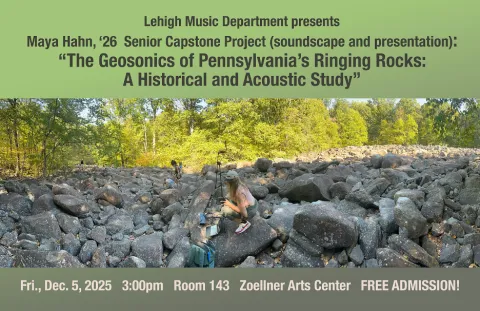
All music majors are required to complete a senior capstone project. A capstone in musicology can take many forms: a research paper, an exhibit, a historical performance guide, or something else entirely. Maya Hahn (Lehigh ‘26), for example, wrote a sonic and environmental history of Pennsylvania’s ringing rocks. These are rocks that "ring" when you strike them with a hammer. A double major in Music and Earth and Environmental Science, Maya drew on literature in geology, sound studies, and musicology to write her history. She also made a series of field recordings and wrote a soundscape piece.