
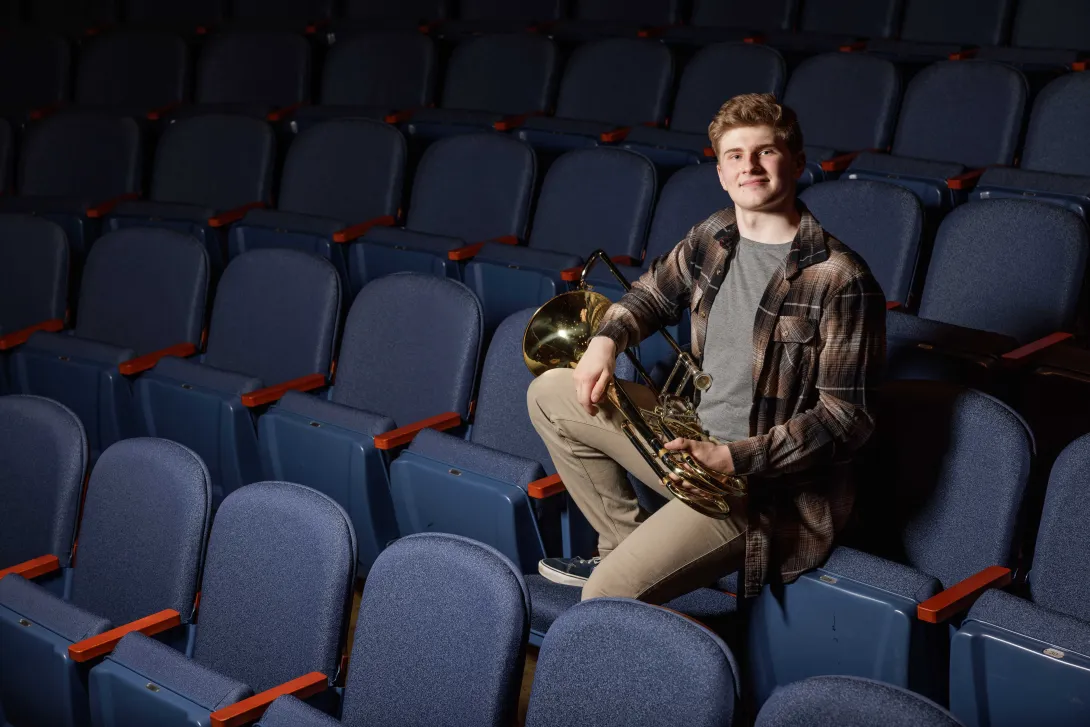
When Shane Duffy ’26 was choosing a university, he knew he needed a place where the arts and sciences didn’t just coexist—they collaborated. At Lehigh he’s found that perfect synergy. Duffy isn’t your typical student. He’s a music and electrical engineering double major, juggling the demands of both. On the one hand, he masters the bass trombone and horn. On the other hand, he dives deep into electronics and the intricacies of acoustics.
His decision to pursue both music and engineering was, initially, "out of left field," he admits, but they started to coalesce last summer when he was an acoustics intern at Crestron Electronics. There he worked on consumer audio devices and power hardware. This experience provided a tangible link between his passion for music and his engineering studies.
The internship was a deep dive into the real-world applications of sound, including the design of Class D amplifiers. “It was a really interesting overlap because it was suddenly, ‘Oh, I really care about the sound quality. I care about these factors because it's going to give us these characteristics that I would want,’” Duffy says, which has inspired his capstone. Part of his senior project is making a Class D amplifier that goes from analog to digital and back again.
Duffy’s impact isn't limited to the lab and practice room. Originally from West Milford, N.J.,, Duffy frequently returns to his high school to continue developing the music program through lessons, consultation on projects like for their new audio system, and teaching.
He also arranges music for his hometown pipe band, Claddagh Pipe Band. He’s done some arranging before, but creating his own material, he says, “that’s really the next step.”
In his composition course at Lehigh, he’s creating an original composition by constructing a theme and variations on a tune for bass trombone and piano. He adds, “It’s a really cool way of expressing humor through, in this case, parody, so it’s been really fun.” His composition course has taught him to think beyond his own instrument. “I’m thinking as a musician. I’m not thinking of just myself as the soloist.”
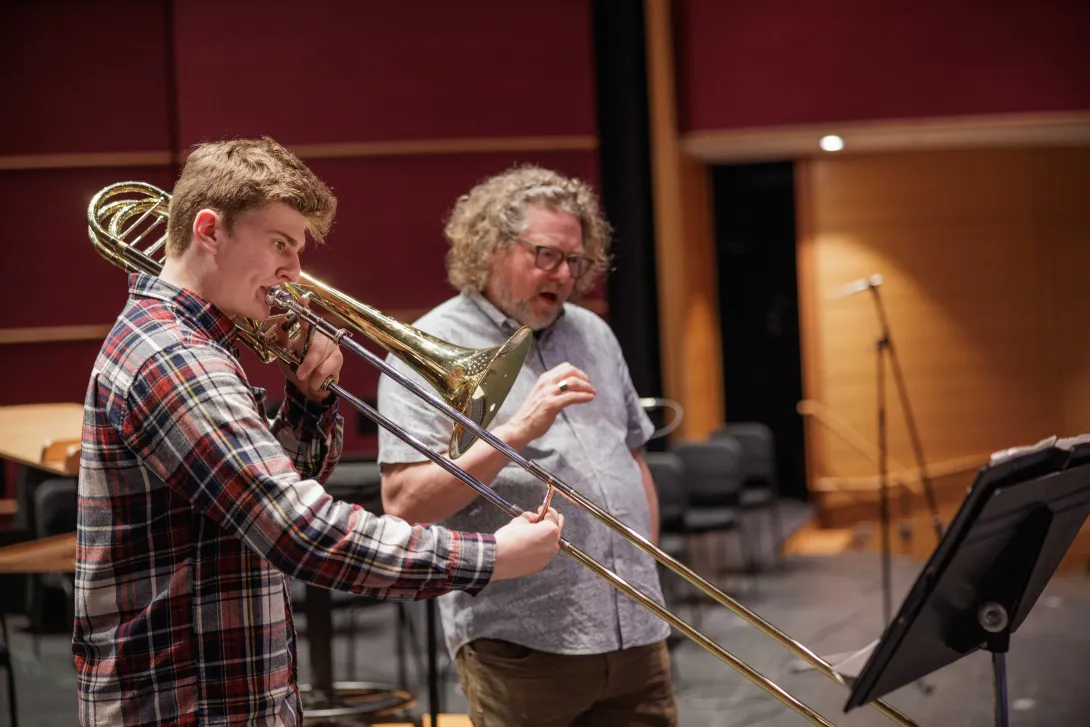
Duffy is a part of eight ensembles in the music department including symphony orchestra, wind ensemble, and jazz band. He appreciates the program's intimate size, which allows him the flexibility to explore different styles and makes him feel like he can truly make a big impact in any ensemble setting. He notes that the bands are open to any student on campus, not just music majors.
Last fall, Duffy took the initiative to relaunch the campus brass quintet with fellow students Chris Giannaras, Marco Clark ’25, Mitchell Roth, and Henry Scott. It’s since blossomed into an ensemble that performs small concerts across campus. He takes pride in passing the torch and watching a group he helped start continue to flourish.
Duffy is amazed by the growth of the music program during his time as an undergraduate. “I feel like this program has grown to be super strong, and it's been really special to be a part of that.”
Duffy highlights not only the talented faculty but also the opportunities to collaborate with professionals. One of the most impactful moments during his time in the music department was working one-on-one with Frank Ticheli, the 2023-2024 Horger artist-in-residence. “I had to play one of his solos for trombone, but getting to meet and interact with the composer, everything became real at that moment.”
As graduation approaches, Duffy’s advice is clear: follow your passions. “If you have something that you really enjoy, just throw yourself at it,” he says. The lessons he’ll carry with him transcend disciplines. “Preparation and continual growth is something that's super valuable when it comes to music and also is applied elsewhere,” he says.
Duffy’s success lies in his resilience and the ability to make connections between both arts and sciences. “The creativity that I find in the arts and that part of my brain, that same creativity is required to, in my opinion, be a good engineer.” By embracing his strengths, Duffy is proving the most dynamic minds are the ones that dare to harmonize creativity and computation.
Spotlight Recipient
Shane Duffy '26
Music and electrical engineering double major